
OMAR Clean-Air Tech Available in AU/NZ
OMAR Clean-Air Tech Available in AU/NZ

Clean-air certainty for Australian and New Zealand industry—powered by OMAR technologies and delivered by Hard Recycle
INTRO
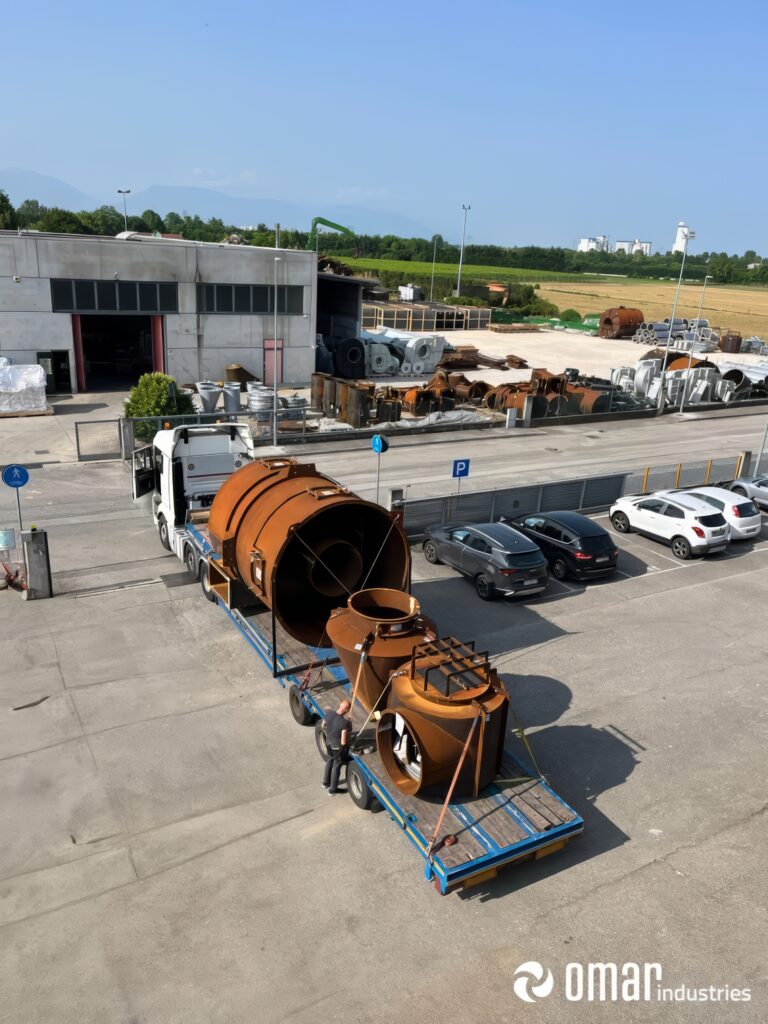
Hard Recycle’s partnership with OMAR Italy delivers four high-performance air-quality technologies that are already redefining safety and compliance in European factories and are now available—fully engineered, installed and supported—across Australia and New Zealand. Each system is matched to local standards, climate and process conditions, then delivered as a turnkey package complete with commissioning, operator training and life-of-plant technical support. Some of the technologies are outlined below, together with the industries where they offer the greatest immediate value in AU/NZ.
1 | Flameless explosion-relief cartridge & bag filters
OMAR integrates a stainless-mesh quench stack behind the explosion vent panel. During a dust deflagration the panel opens but the mesh cools the flame and dumps pressure to <0.2 bar, so the filter can be installed indoors without an external vent duct.
Ideal local applications
-
Flour milling and feed production—NSW mills that experienced combustible-dust incidents in 2018 are upgrading to indoor filters that meet AS/NZS 4745 while cutting fan energy and weatherproofing costs.
-
Engineered-wood board plants—like Borg’s MDF and particle-board facilities at Oberon (NSW) and Mount Gambier (SA) routinely handle resin-rich wood dust; indoor placement keeps duct runs short and minimises fire risk in winter.
- Metal additive-manufacturing bureaus—Melbourne service centres producing fine aluminium and titanium powders benefit from reduced housekeeping and easier maintenance access.
Key benefits
-
15 % fan-power saving versus roof-mount filters
-
No weather covers or cyclone tie-downs needed in cyclonic regions
-
Full documentation for IECEx sellers’ declaration and insurer sign-off
2 | Pre-blast cyclones for coarse, abrasive or spark-bearing dust
The pre-separator cyclone drops 60–70 % of material >50 µm before it ever reaches the filter media. Bodies are available in Corten or Hardox; Hard Recycle sizes the vortex finder and cone angle to your actual flow and bulk density.
Ideal local applications
-
Aluminium extrusion swarf capture—Capral’s Bremer Park extrusion plant in Bundamba, QLD, produces tonnes of hot, sharp chips every shift; cyclones slash bag wear and pulse-air consumption.
-
Bulk grain export terminals—Viterra’s Port Adelaide Inner & Outer Harbour elevators load grain at 2 000 t h-¹; cyclones intercept husk and silica before compact filters, helping to meet dust-fall limits at neighbouring berths.
- Mobile scrap-metal shredders—Regional Sims Metal units use skid-mounted cyclones to knock out sparks and tramp before downstream cartridges during site moves. (internal project data).
Key benefits
-
Doubles bag or cartridge life in chip, husk and glass-fibre duties
-
Cuts compressed-air demand by up to 40 %
-
Acts as a passive spark arrestor—no moving parts, no electrics
3 | Variable-throat Venturi wet scrubbers
A motorised ogive continuously adjusts throat width so pressure drop—and therefore collection efficiency—stays flat even when airflow swings ±30 %. Water injected ahead of the throat atomises to <100 µm, giving ≥99 % removal at 1 µm.
Ideal local applications
-
Hot-dip galvanising—Hartway Galvanizers operates two large plants in Canning Vale and Naval Base, WA; Venturis capture ZnO fume and HCl mist, keeping stack opacity and acid emissions within licence.
-
Aluminium die-casting—Melbourne foundries such as Alliance Connect in Carrum Downs generate sub-micron oil smoke that fabric filters cannot handle; Venturis maintain efficiency during mould-change pauses.
- Lithium hydroxide refineries—Both Tianqi/IGO’s Kwinana line and Albemarle’s Kemerton complex vent acid-gas streams during spodumene conversion; variable-throat Venturis give stable capture despite batch-process flow swings.
Key benefits
-
Licence compliance across the full duty curve—no “low-load” gaps
-
Optional zero-liquid-discharge loop with sludge dewatering
-
CFD-verified droplet residence time to avoid re-entrainment
4 | Dual- and triple-stage polypropylene packed-bed scrubbers
Entirely fabricated in chemically resistant PP, these horizontal vessels provide sequential alkaline, acidic and oxidative stages for high-load odour or acid-gas duties up to 60 °C.
Ideal local applications
-
Municipal wastewater treatment—Auckland’s Māngere plant, Brisbane’s Luggage Point Resource Recovery Centre and Sydney Water’s Malabar STP all treat >700 000 m³ d-¹; PP scrubbers handle H₂S and NH₃ from digesters while resisting chloride attack.
-
Animal-by-product rendering—Baiada’s new Tamworth poultry complex will produce high-moisture vapour with strong sulphur compounds; dual-stage scrubbers meet EPA odour thresholds without corroding.
- Composting & green-waste facilities—regional councils running in-vessel composting lines adopt the same PP units to keep boundary odour below 500 OU m-³ (state guideline).
Key benefits
- 99 % H₂S and mercaptan removal; outlet <0.1 ppm typical
-
Quick-release nozzle decks cut media-change downtime to one shift
-
No exterior coatings—15-year service life even in marine air
Integrated project delivery — every step accounted for
-
Front-end engineering Hard Recycle records real airflow rates, determines dust-explosibility indices (Kₛₜ, Pₘₐₓ) and samples gas chemistry before design begins. Those data drive calculations to AS 1210, AS 1657, AS/NZS 3000 and AS/NZS 4745, while wind, seismic and live-load cases are checked with finite-element models to satisfy the National Construction Code.
-
Equipment supply Orders are released to OMAR’s Veneto factory and shipped in consolidated weekly containers. Hard Recycle prepares all import and quarantine paperwork, clears customs and co-ordinates road or rail to site so components arrive in sequence and without demurrage.
-
Installation & commissioning Lift studies, crane scheduling, rigging supervision, mechanical tie-ins, VSD-fan tuning, reagent-dosing calibration and witnessed acceptance tests are included as standard. Handover occurs only after airflow, pressure-drop, emission and safety targets are proven under full-load, part-load and upset conditions.
-
Training & lifecycle support Operator courses align with state and federal WHS rules. Critical spares—filter media, valves, membranes and sensors—are warehoused in Brisbane for delivery anywhere in Australia or New Zealand within five days. Optional agreements add scheduled bag or media audits, vibration trending and annual explosion-vent inspections to AS 5067, ensuring each system performs exactly as designed throughout its life.
The outcome is a single accountable partner from the first airflow measurement to the tenth-year overhaul.
Sector-specific impact and future opportunities
-
Food & beverage Indoor flameless filters now let flour and feed mills in New South Wales retrofit high-capacity dust capture on mezzanine levels without roof penetrations, while variable-throat Venturi scrubbers remove acetic vapour at Queensland vinegar fermenters and strip citrus-oil aerosols at South Australian juice concentrators.
-
Metals Pre-blast cyclones protect cartridge filters at Capral’s Bremer Park aluminium extrusion plant in Bundamba, doubling bag life and cutting compressed-air use, and variable-throat Venturi scrubbers on galvanising lines at Canning Vale and Naval Base keep zinc-oxide and hydrochloric-acid emissions below licence thresholds at any production rate.
-
Waste & recycling Dual-stage polypropylene scrubbers at large wastewater facilities such as Luggage Point in Brisbane and Malabar in Sydney routinely drive hydrogen-sulphide below 0.1 ppm at the boundary, while flameless-vented filters enable lithium-battery and e-scrap shredding lines to control explosive dust indoors without costly rooftop ducts.
-
Pulp & paper High-temperature variable-throat Venturis at Visy’s Tumut mill quench sulphur-dioxide spikes from the lime kiln, and polypropylene packed-bed units remove reduced-sulphur compounds from condensate-stripper off-gas before stack discharge, helping the site maintain its EPA licence.
- Energy & critical minerals High-capacity cyclones ahead of baghouses at the East Rockingham waste-to-energy plant strip alkali salts and coarse ash, preventing filter blinding and reducing lime use, while lithium-hydroxide refineries at Kwinana and Kemerton specify variable-throat Venturis with dual caustic-oxidant stages to manage acid-bearing vent streams from spodumene conversion.
Across all of these sectors, OMAR’s European hardware—delivered, installed and maintained by Hard Recycle—provides a low-risk, standards-compliant path to cleaner air, safer operation and assured regulatory compliance for decades to come.
Take the Next Step Toward Safer, Cleaner Production
Hard Recycle stands ready to evaluate your dust-collection or gas-scrubbing challenge. Whether you need indoor placement, abrasive-dust pre-separation, sub-micron fume capture or aggressive-odour abatement, a fully engineered OMAR solution is available today. Contact our engineering team for a detailed airflow assessment or to arrange a site visit; we will configure, supply and support a system that meets Australian and New Zealand standards from day one and delivers clean-air certainty for years to come.