Tecnofer’s Advanced Plastic Washing Lines
Tecnofer’s Advanced Plastic Washing Lines

Tecnofer’s Modular Washing Lines: Efficient Solutions for Plastic Recycling
INTRO
RecyclingInside recently profiled Tecnofer Ecoimpianti’s breakthrough plastic washing lines, and for good reason. Since its founding in 1976, Tecnofer has honed a modular, fully automated approach that tackles the toughest post-consumer and post-industrial plastic waste streams. From lightweight agricultural films to heavily soiled rigid containers, Tecnofer’s systems deliver consistent, high-purity recyclate—ready for mechanical or chemical reprocessing. What follows is an in-depth look at the technical underpinnings of those systems, the actual equipment models on offer, and how they combine to set new standards in efficiency and throughput.
Modular Design and Flexible Cleaning Processes
At the heart of every Tecnofer line lies the “Choose Your Cleaning Process” philosophy. Operators can select dry cleaning, cold washing, hot washing with chemical dosing, or full thermal drying according to feedstock type and contamination level. The dry cleaning mode employs high-speed friction to separate plastics with minimal water use—ideal for relatively clean polyethylene films destined for chemical recycling. Cold washing combines friction washers with low-temperature tanks to float off grit, sand and labels from mixed polyolefin flakes. For applications requiring food-grade purity, the hot treatment unit (known as the MTC System) circulates a heated detergent solution at controlled temperature and residence time, dissolving oils, inks and adhesives. Finally, the advanced drying system pairs a mechanical screw press with a fluid-bed thermal dryer to reduce moisture content from upwards of 50 per cent down to just 2 per cent, readying material for sensitive downstream processes.
Core Equipment Modules
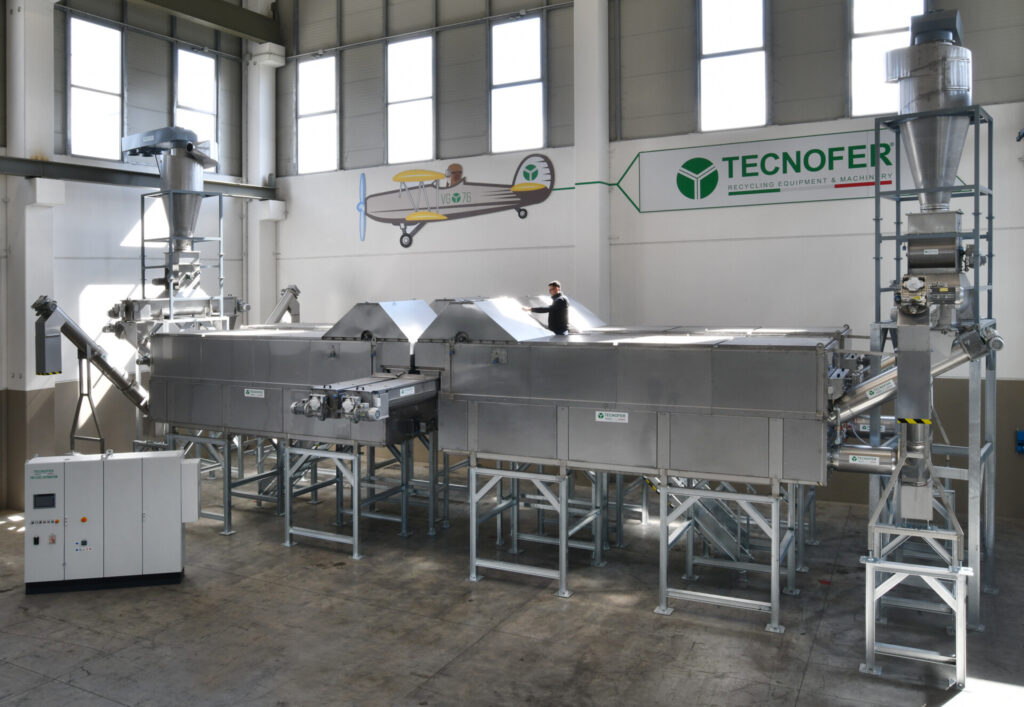
Tecnofer’s lines are built from six principal modules, each engineered for reliability and serviceability. The Pre-Washing Tank uses calibrated water and air injection to float off heavy contaminants; settled debris is automatically expelled via a swing-valve discharge. Downstream, the Friction Washer features a robust inner rotor that spins flakes against stainless steel baskets, scrubbing away adhered dirt before screening particles from process water. The Density Separator Tank then exploits the natural buoyancy differences between polyolefins and sink fractions, continuously skimming floating plastics while discharging sediments. The MTC System follows for hard plastics—PET bottles, HDPE drums, PP crates—maintaining precise chemical dosing, temperature control and agitation under PLC supervision. To handle severely contaminated or super-absorbent feedstocks, Tecnofer offers the Dynamic Centrifuge in two models (CD720X1500 and CD850X1500, with optional “W” variants), each delivering up to 45 kilowatts of drive power to combine washing and partial dewatering in a single step. Finally, the Squeezer (or Screw Press) at the line’s end mechanically expels bulk water before material enters the fluid-bed dryer.
Sustainable and Energy-Efficient Operation
Tecnofer recognises that water, energy and chemical consumption heavily influence both environmental footprint and operating costs. Accordingly, all modules integrate closed-loop recirculation pumps, minimising fresh-water draw, while clean-out cycles purge and concentrate solids for off-site disposal. The friction washer’s perforated baskets trap particulates before they enter recirculation, reducing wash-water turbidity and chemical demand. In hot-wash mode, dosing pumps deliver only the precise quantity of detergent necessary, avoiding excess usage. Across the portfolio, automated controls monitor flow rates, temperatures and torque loads in real time—optimising performance and triggering self-cleaning sequences to avoid manual intervention.
Advanced Drying System: High Throughput, Low Energy
A standout feature of Tecnofer’s washing lines is the two-stage drying arrangement. First, the screw-press squeezer reduces moisture content to around 15 per cent by applying hydraulic pressure to the flake cake. This step slashes the thermal load required for final drying. Next, the fluid-bed dryer exposes flakes to a rapidly circulating hot-air stream, evaporating residual water. Thanks to decades of R&D, Tecnofer’s dryers achieve a final moisture content of just 2 per cent while consuming approximately 0.17 kW per kilogram of processed material—among the lowest specific energy consumptions in the industry. This efficiency translates into reduced fuel or grid-electricity costs and lower carbon emissions per tonne of recyclate produced.
Complete Line Configurations
Tecnofer offers tailored configurations for both film and rigid-plastic applications. Film and big-bag washing lines process between 500 kg and 3 000 kg per hour of LDPE or LLDPE film and up to 1 000 kg per hour of PP woven sacks. These lines integrate all core modules—pre-wash, friction washer, density separator, hot treatment (optional) and dewatering—for seamless, single-pass cleaning. Rigid-plastic lines, designed for PET bottles, HDPE drums, PP crates and even automotive bumpers, emphasise robust structural steel construction and oversized sieves and conveyors to manage irregular shapes and high throughput. Both line types feature quick-change screens and modular mounts, allowing rapid re-tooling from one feedstock to another with minimal downtime.
Case Study: Ecosistem Srl Agricultural Film Recycling
In 2014, Ecosistem Srl commissioned Tecnofer to tackle large volumes of agricultural LDPE-LLDPE film. The installation comprised a film line rated at 2.5 tonnes per hour—including a dry friction washer for initial soil removal, cold-wash density separation and the MTC System for deep cleaning—followed by the specialised screw-press and fluid-bed dryer. Parallel to that, an HDPE-PP line valorised used crates and chemical drums from the same facility. By modularising the equipment, Ecosistem could seamlessly switch between film and rigid streams, maximising plant utilisation. The result was a consistent output of high-purity film flakes suitable for film-to-film extrusion and rigid plastics meeting food-contact standards.
Meeting Industry Demands with High-Quality Recyclate
Recyclers face ever-tightening quality specifications, whether for blow-moulded containers, extrusion lines or advanced chemical depolymerisation. Tecnofer’s multi-mode approach ensures that inks, labels, adhesives and residual fats are removed to below detectable thresholds. Automated process recipes can be saved and recalled for repeat batches, guaranteeing reproducible results. Moreover, the hygienic design—full stainless steel contact, sloped surfaces for rapid drainage and CIP (clean-in-place) options—makes these lines suitable for pharmaceutical and food-grade recycling applications.
Conclusion
Tecnofer Ecoimpianti’s plastic washing lines embody a marriage of flexibility, efficiency and modular engineering. By allowing operators to choose cleaning intensity—dry, cold, hot or thermal drying—they avoid unnecessary water and energy use. The integration of advanced friction washers, density separators, the MTC hot-wash system, high-power Dynamic Centrifuges and low-energy fluid-bed dryers delivers a complete solution that meets the most exacting industrial and environmental standards. For recyclers aiming to transform contaminated waste into premium-grade recyclate, Tecnofer’s “beyond the boundaries” philosophy translates into real operational gains: lower utility costs, reduced downtime and superior material quality. Whether processing film, big bags, rigid containers or mixed fractions, these systems set a new benchmark in plastic recycling technology.