PV Recycling for ANZ — Powered by ITR
PV Recycling for ANZ — Powered by ITR

PV panel recycling for Australia & New Zealand — industrial scale, delivered by Hard Recycle with ITR Recycling Systems
INTRO
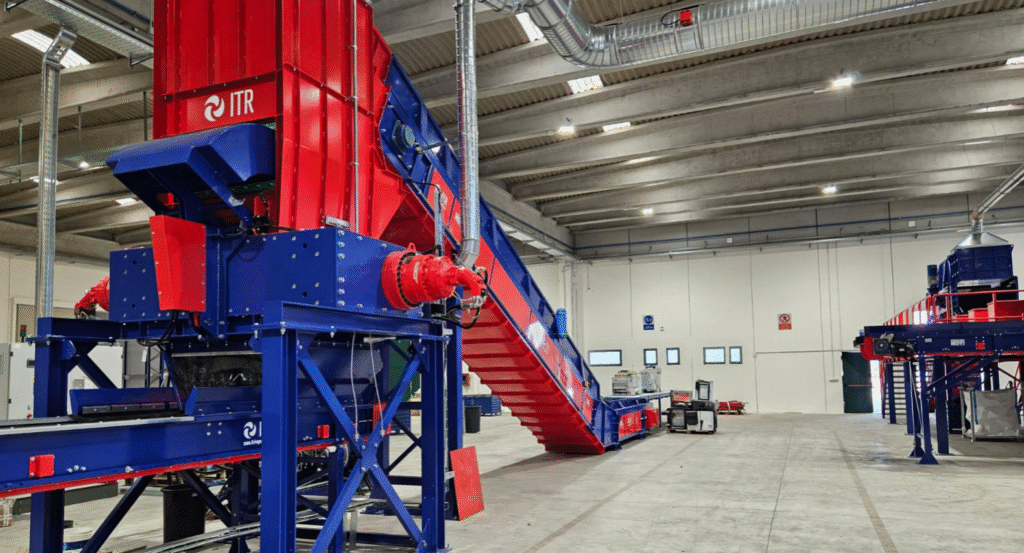
Australia and New Zealand are entering the first substantive replacement cycle for solar modules. What was once a forecast is becoming a steady, measurable waste stream driven by warranty returns, storm damage, early repowering and end-of-life retirements. Volumes are already in the tens of thousands of tonnes per year and will trend toward six figures through the 2030s. The operating requirement is clear: proven, industrial equipment that turns mixed panels into clean, saleable fractions with controlled emissions, predictable throughput and a straightforward path to approvals. Hard Recycle represents ITR Recycling Systems across Australia and New Zealand and delivers exactly that—fully engineered, automated plants designed for photovoltaic modules, commissioned to numbers, and supported locally for the life of the asset.
About ITR Recycling Systems
ITR is a European manufacturer with decades of know-how in mechanical size-reduction and separation: pre-shredders, primary and secondary shredders, hammer mills, screens, over-belt magnets, eddy-current separators and integrated dust control, supplied as modular systems or complete lines. Their plants run globally on streams ranging from WEEE and light ferrous to aluminium profiles, tyres and MSW-derived fractions. For photovoltaics, ITR applies this experience to a dedicated flowsheet that is selective, automated and low-emission. Tooling packages, wear protections and drive trains are configured for laminated glass and metal conductors rather than generic MSW duty, so you get repeatable liberation without excessive fines. Control architecture is standardised—VFDs on critical drives, torque and temperature monitoring at the shredder, HMI/PLC with remote diagnostics—which shortens commissioning and simplifies training and maintenance.
Process architecture built for PV
What we—together with ITR—offer the market is a mechanical, fully enclosed and interlocked treatment line that accepts all common module constructions, including glass-glass, bifacial and larger-format panels now entering the waste stream. The plant is modular from infeed to bunkers so it can be right-sized today and scaled tomorrow without re-pouring the slab.
Modules enter via a metered feed and a primary shredding stage configured to the commercial target. Shredder tip speed, knife profile and grate aperture are set to balance glass platelet preservation against conductor liberation. Where glass revenue dominates, we bias to a coarser cut and lower impact energy; where non-ferrous uplift is the focus, we tighten the geometry and increase dwell to free busbars and ribbons cleanly. Jam detection and auto-reverse protect the drivetrain against tramp.
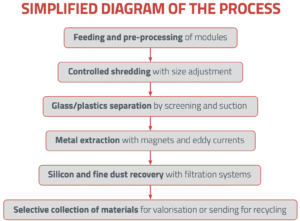
Downstream of primary reduction, a vibratory screen and air-knife make the first high-value split: a glass-rich fraction drops through the deck while a light fraction of encapsulant and backsheet films is carried forward. Screen deck selection (aperture and open area) and air-knife velocity are tuned together so glass exits with low polymer carry-over and the light fraction arrives with minimal glass fines.
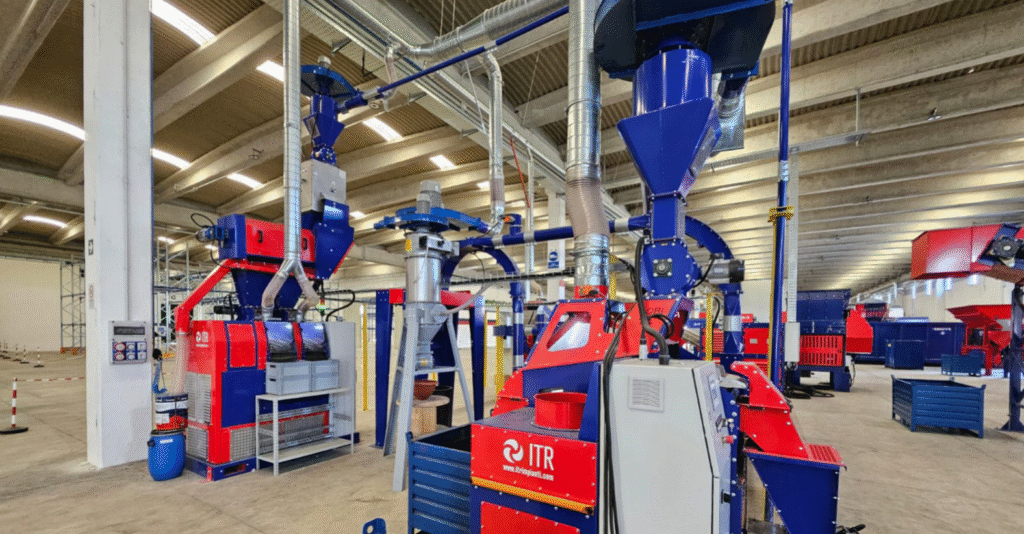
An over-belt magnet removes ferrous items, protecting the non-ferrous stage. An eddy-current separator then ejects aluminium frames, junction-box heat sinks and clean copper-bearing conductors. Where the feed mix warrants it, a second EC stage or polishing step can be added to increase non-ferrous yield. Cable harnesses and junction-box components are routed via a side path either back to the non-ferrous stream or to dedicated electricals handling, depending on your offtake contracts.
All transfer points are dust-tight. A dedicated filter captures silicon-bearing fines at source, and the enclosure is designed for negative-pressure operation so emissions are controlled within the machine envelope rather than diluted by general ventilation. The result is five principal product streams—glass, aluminium, copper conductors, plastics and silicon-rich fines—discharged to separate bunkers with the cleanliness required by domestic buyers.
Throughput for a single PV train is engineered in the 3–4 tonnes per hour band in continuous service. That supports a 20–30 ktpa state-scale facility on one shift or a 50–60 ktpa metropolitan hub on two lines with standard maintenance windows. Because the system is modular, capacity can be stepped by adding a second shredder/screening train, an additional eddy-current stage or expanded bunkering without redesigning the entire plant.
Safety, compliance and environmental performance
Safety is designed in, not added later. Interlocked access points, fixed and interlocked guards, nip protection and automatic jam management limit human interaction with moving parts. Enclosed conveyors and dust-tight chutes prevent fugitive emissions; extraction points are integral, not improvised. For operators, that translates to a simpler WHS risk register, easier inductions and faster insurer sign-offs.
From an environmental perspective, the process is dry and mechanical—no thermal cracking, no solvent baths. That removes a major barrier to approvals and site selection, reduces licencing complexity and avoids ongoing reagent logistics. Where a site requires odour control around polymer conditioning, localised capture and treatment can be added without touching the core line. Hard Recycle documents airflow and capture points, provides structural and anchorage calculations to the National Construction Code, and prepares the electrical and functional safety dossiers required by state regulators. Acceptance testing at handover includes verified throughput, energy draw, fraction purity and emission checks at key points.
Commercial outputs that fit AU/NZ markets
Clean glass is the mass driver and moves into established cullet and engineered-materials channels depending on specification. Aluminium frames have a mature domestic market; copper conductors do as well. Plastics (encapsulants and backsheets) are managed per jurisdiction—densified for processing or directed to energy recovery where permitted. Silicon-rich fines are captured and containerised for specialised downstream options as local re-melting or chemical routes mature. The common thread is fraction cleanliness. By tuning shredder geometry, deck selection and air-knife velocity to your revenue stack, we deliver streams that clear quality thresholds consistently rather than intermittently, which is critical for bankability.
What Hard Recycle delivers locally
Hard Recycle takes end-to-end responsibility. We start with a baseline of your catchment—module types, age profile, anticipated inbound variability and transport distances—and build a mass-balance to size the line. We then issue the mechanical, structural and electrical packs against Australian and New Zealand standards, including airflow, dust explosibility considerations and functional safety. Equipment is manufactured in Italy and shipped to your slab in sequenced modules. We manage import, quarantine and customs, co-ordinate cranage and mechanical fit-out, integrate MCC/PLC elements with your plant network and commission to numbers: treatment capacity, fraction purity, pressure balance and power draw. After handover, operators and maintainers are trained to site procedures; critical spares—knives, belts, bearings, sensors—are warehoused in Brisbane for five-day coverage across Australia and New Zealand; and scheduled audits track wear, liberation quality and downtime drivers so recovery stays on-spec.
Why this approach fits the AU/NZ context
Two realities shape the local business case. First, volumes will keep rising as early residential systems are replaced and the first wave of utility-scale assets begins repowering. Second, policy is tightening—Victoria’s e-waste landfill ban is already in force, and a national product-stewardship framework is moving into focus—yet the exact contours will vary by state for some time. Operators need plants that can be financed, approved and run now, with resilience as rules evolve. A selective, mechanical line with integrated dust control meets that test: it accepts all common module designs, keeps emissions low, avoids solvent inventories and outputs fractions domestic buyers already understand.
The industrial landscape is also shifting from pilots to scale. Early facilities are proving the model, but a national system requires metropolitan hubs supported by regional depots and transfer capacity. Hard Recycle can stand up single-line state plants in the 20–30 ktpa band quickly, with civil allowances and services in place for a second train, and can deliver dual-line metro hubs as volumes consolidate.
Where next—and how fast?
From 2026–2027, early movers will secure sites, approvals and offtake, and stand up one-line plants with space and power provisioned for expansion. Between 2028 and 2030, dual-line metro hubs will come online as national flows cross the 50 kt threshold; at that point, second eddy-current stages and additional screening may be added where aluminium and copper pricing justifies the uplift. Into the 2030s, as utility-scale decommissions increase and the share of larger, heavier, glass-glass modules rises, the same acceptance window and modular design keep plants viable: heavier infeed, additional glass handling or expanded bunkers can be retrofitted without replacing the core equipment. Across all scenarios, the gating factors are the same—reliable throughput, selective separation, clean fractions and low emissions—delivered with predictable capex, opex and performance.
Conclusion
If you have catchment data and a deployment window, we can build a defensible business case, specify the right ITR configuration and stand up an operating plant to the performance figures above. Australia and New Zealand need PV recycling infrastructure at industrial scale. With ITR’s mature technology and Hard Recycle’s local engineering, compliance and service, that infrastructure can be in place on realistic budgets and timelines—and ready to grow as volumes climb.