ARP machining & die casting recycling tech
ARP machining & die casting recycling tech

ARP chip-recycling technology focused on machining & die casting industries
INTRO
From swarf at the spindle to clean chips in a silo—or metered feed into a furnace.
Hard Recycle represents ARP GmbH & Co. KG in Australia and New Zealand. ARP’s kit is built for the real world of machining and die casting: long stringy swarf (long turnings) that jam pipes, wet chips that drag coolant losses, and foundries that need a steady, dry aluminium feed.
The system is modular—on-machine shredding, sealed transfer by vacuum or pump, centrifugal de-oiling/drying, briquetting, silo logistics, and heated, metered furnace feed—so you assemble only what you need.
1) Kill long stringy swarf at the source
Long stringy swarf (long turnings) causes most downstream pain. ARP’s machine-side unit adds a shaped hopper and compact shredder on a baseframe aligned to the machine conveyor or chip trolley. Doors are interlocked; overload protection and a host-machine interface are standard. Optional trolley-presence and hopper-level sensing remove operator guesswork. The output is short, free-flowing swarf that won’t choke a pump intake or vacuum main.
Why it matters: once swarf is short, every downstream operation—pumping, vacuum conveying, centrifuging, briquetting—stays inside its design window.
2) Compact cell: dry chips and recovered coolant, no drama
For one or two machines (or a small bay), ARP’s compact cell wraps infeed, size reduction and de-oiling into a single, level-controlled module:
-
A hinged-belt infeed with a ~1.5 m³ hopper meters swarf to a ZW-series shredder (e.g., ZW 400 class).
-
A continuous centrifuge (~Ø 400 mm drum at ~1,400 rpm) strips oil/emulsion so discharge is dry and free-flowing; recovered liquid is routed to treatment or back to process.
-
A scraper conveyor with a 360° swivel tube distributes into two containers with auto detection and fill-level monitoring.
Result: clean chips in labelled bins, coolant captured—not running across the floor.
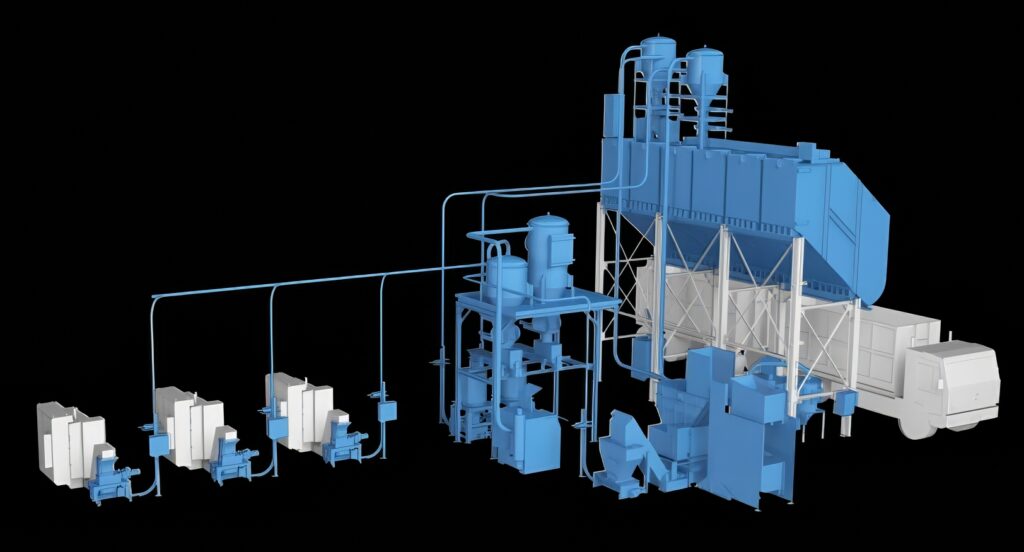
ARP Chip extraction system with centrifuges and silo distribution
3) Compact cell with briquetting: shrink the volume, raise the value
When transport value and housekeeping are the drivers, swap the centrifuge/distribution tail for a briquetter:
-
Pre-cut with a ZW 500 class shredder to keep geometry consistent.
-
Feed a ~15 kW press that compacts to Ø 70 × 90 mm briquettes (~1.2 kg each) at high specific pressure.
-
Expect significant oil recovery from feeds carrying 10–15% liquid.
What changes: fewer forklift moves, easier storage, higher $/tonne from scrap buyers, and furnace-friendly geometry if you melt in-house.
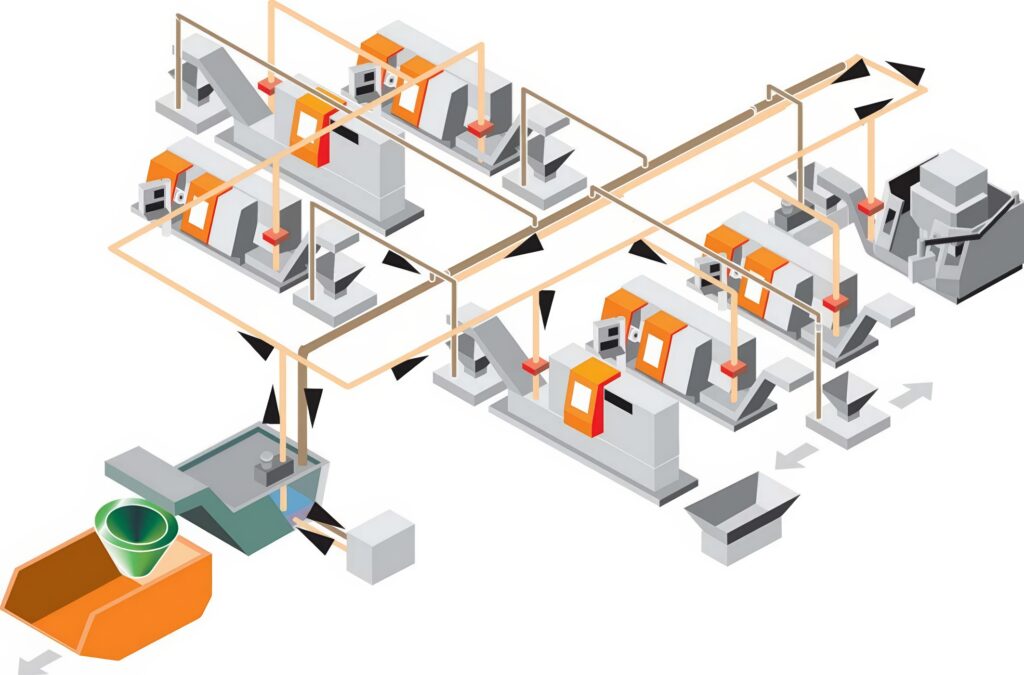
ARP: Design of the plant: Diagram of central coolant supply and disposal
4) Central vacuum extraction: sealed, scalable, low-mess
When dozens of machines and changing alloys are in play, vacuum systems keep housekeeping under control and make moves/adds/changes simple:
-
Machine-level suction units (VSS) combine a shredder, screw conveyor and valve.
-
A single extraction loop can service several bays; off-gas is filtered, chips go straight to automatic centrifuges (continuous or lifting-bottom) and on to silo distribution.
-
Alloy segregation, magnet stages and silo weighing are part of the standard options.
Why vacuum over pump here: enclosed pipework, minimal operator touch, and straightforward expansion as lines move.
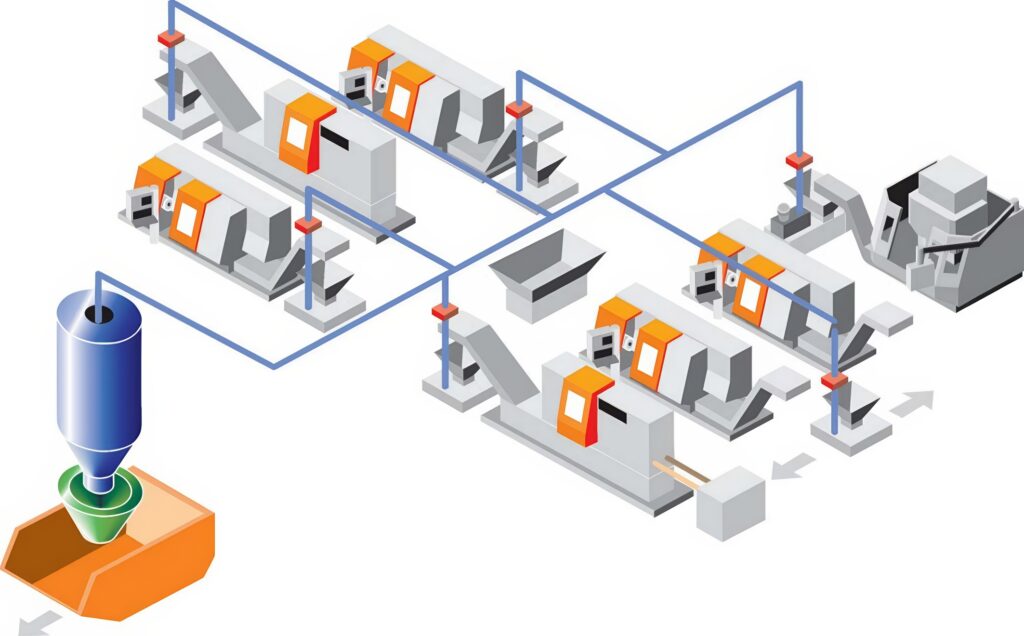
ARP: Design of the plant: diagram of a central vaccum suction station
5) Pump-station architecture: when chips and coolant travel together
If you convey with the liquid, swarf length becomes the deciding parameter. Above-floor pump stations with integrated pre-cut keep everything accessible and avoid trenches. Typical practice:
-
Keep swarf at or below the practical pumpability length band (turning/boring swarf usually needs pre-cut; milling/cutting swarf often doesn’t).
-
Place the cutting unit directly over the sump; use ultrasonic level control for pump on/off; include overfill protection.
-
Use screw-assisted variants where a DN-class flange and controlled solids dosing improve stability.
Outcome: controlled coolant/solids logistics without sludge traps—and a layout you can reroute when bays change.
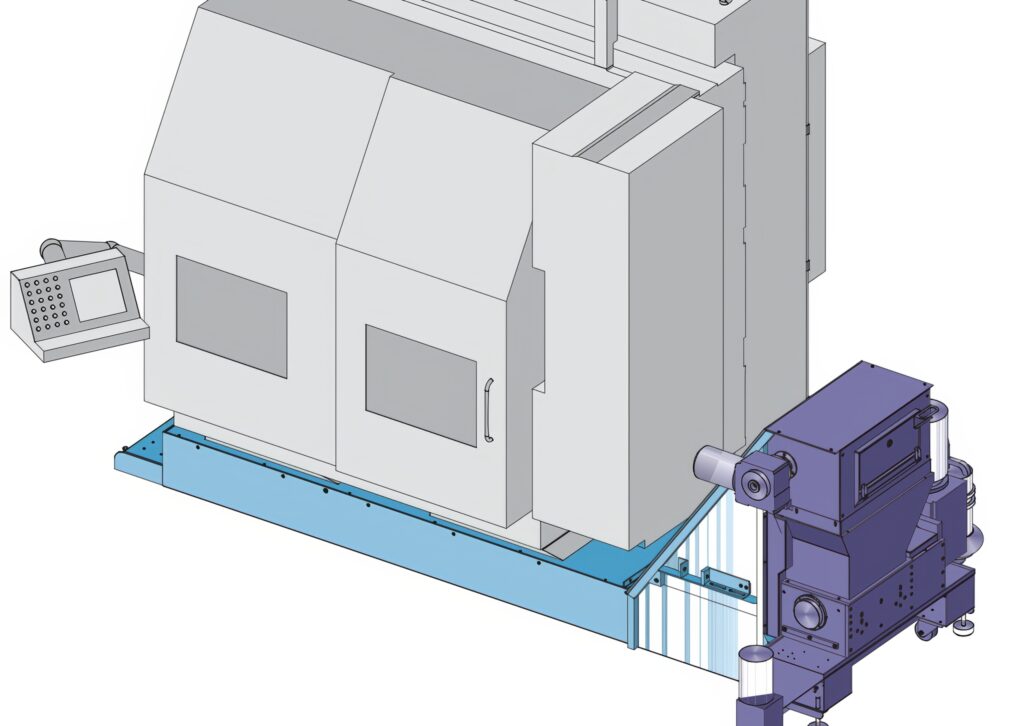
ARP Chip Pumping Station
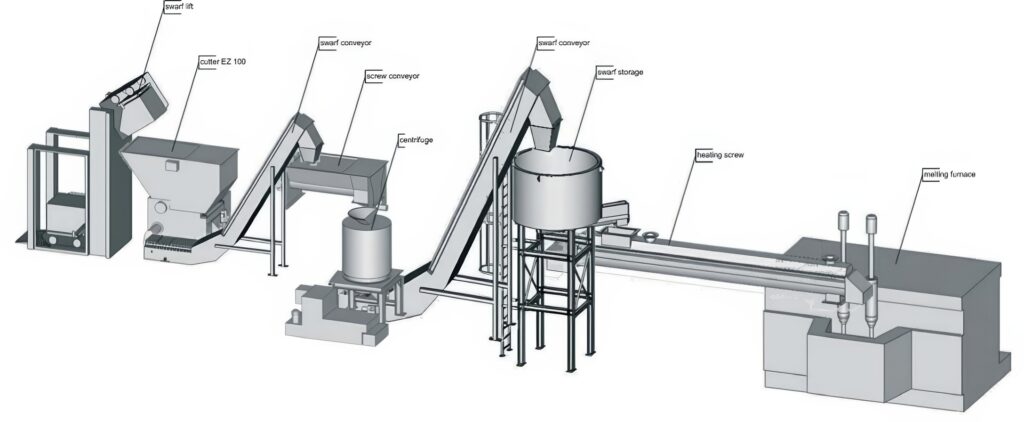
6) Aluminium swarf processing to remelt: feed the furnace, don’t fight it
For foundries and die-casters returning internal scrap, ARP’s aluminium route integrates the steps that matter to yield and safety:
-
Crush to defined chip size.
-
Centrifuge to remove oil/emulsion and dry the swarf.
-
Magnet to remove ferrous contamination.
-
Heating screw to reduce residual moisture and meter the feed into the melting furnace at a controlled rate.
Design intent: a steady, preheated feed (waste-heat or dedicated heater) and typical burn-off in the low single-digits—because the furnace gets a constant diet instead of slugs. Conveyors, dosing screws and surge hoppers are sized as one system so the tap temperature, not the scrap stream, dictates the rhythm.
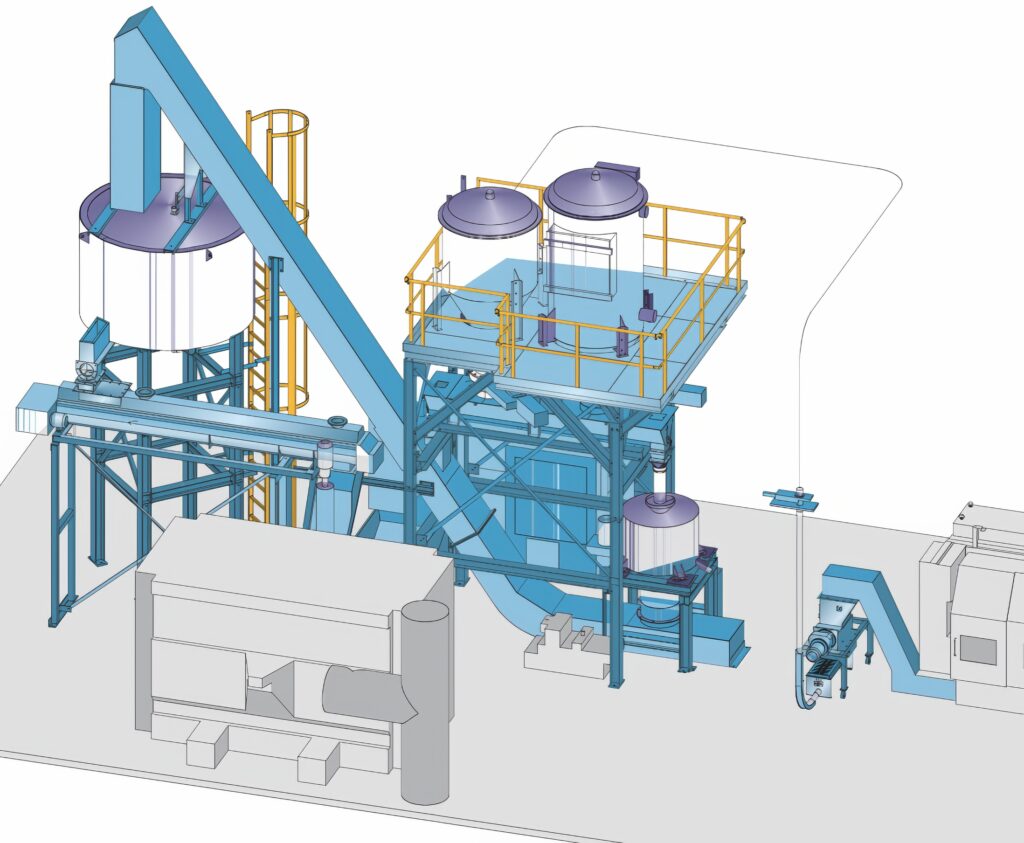
ARP Cell to plant metals swarf
7) Die casting: the cell-to-bunker picture
High-volume die casting adds runners and trim to the swarf story. The same modules build a clean path from press to bunker: crush at the cell, sealed transfer (vacuum for dry/self-supply, pump for coolant-rich), moisture reduction by centrifuge, ferrous knock-out if melting, and orderly storage in containers or silos. Magnesium and sensitive aluminium alloys benefit from the same dryness and contamination control—with the heating screw as the final guardrail before melt.
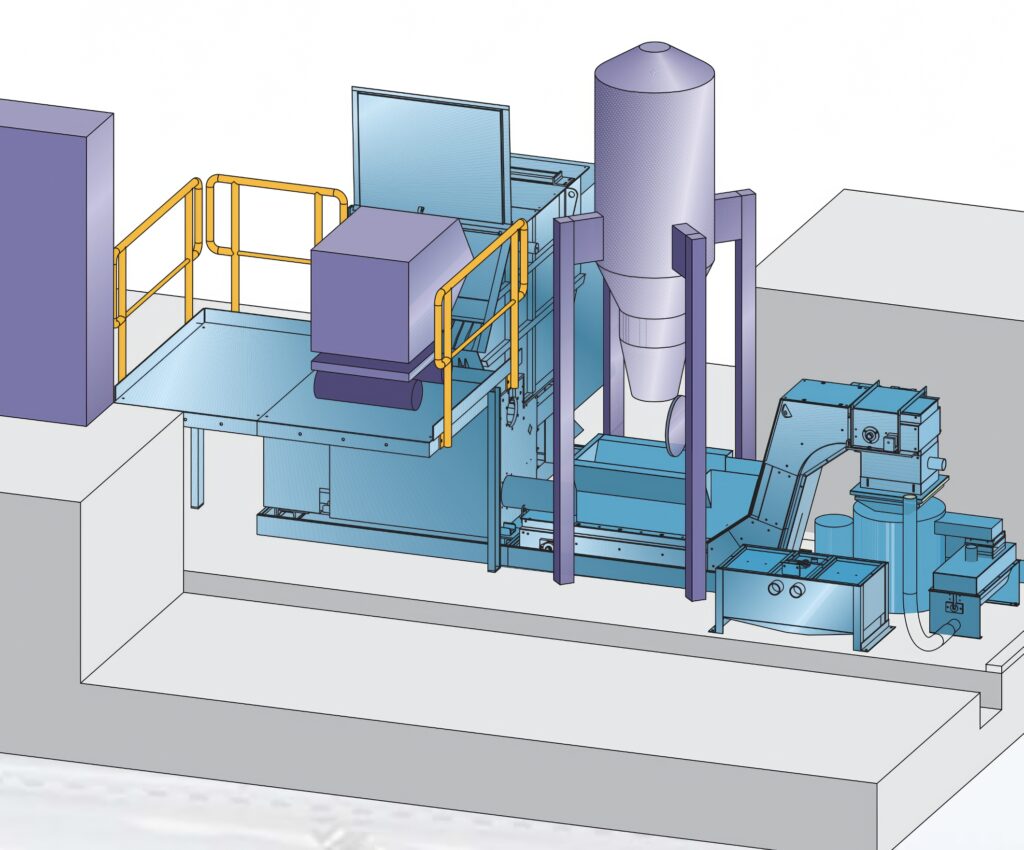
ARP Cell to Bunker Metals Swarf Recycling
Outcomes that matter to AU/NZ operators
-
Higher availability: short swarf doesn’t clog; enclosed transfer keeps aisles clean; blower rooms and filtration are kept out of the chip dust.
-
Lower consumables cost: coolant is recovered at the chip sump, not mopped up; fewer emergency pump rebuilds.
-
Better scrap economics: drier swarf, briquettes where needed, and clean alloy segregation pay back every pickup.
-
Safer melt practice: controlled, preheated swarf feed reduces pops, smoke and variability at the furnace.
How Hard Recycle delivers it locally
As AZO’s and ARP’s partner in Australia and New Zealand, Hard Recycle designs, installs and supports these systems to local codes. That means we:
-
pick vacuum vs pump per bay based on swarf morphology and coolant regime;
-
match shredder geometry to the swarf you actually produce;
-
size centrifuges and (where required) briquetters to the dryness/density targets you set;
-
engineer silo/container logistics around your truck schedule and alloy segregation;
-
integrate interlocks, earthing, guarding and controls to AS/NZS practice;
-
commission against measurable outcomes (dryness at the centrifuge, briquette integrity and oil recovery where used, and—as applicable—stable, metered remelt feed).
If you want this mapped to your bays, we’ll build a process flow and equipment list from your swarf samples, duty hours, distances and coolant data—no generic promises, just an engineered line that runs.