Tecnofer Plastic Film Lines now in AU/NZ
Tecnofer Plastic Film Lines now in AU/NZ

Hard Recycle + Tecnofer: Film-Washing Lines Engineered for AU/NZ Conditions
INTRO
Recycling post-consumer and post-industrial films (LDPE/LLDPE/PP) in Australia and New Zealand is constrained by variable contamination, moisture, mixed polymers, bale inconsistency, and tight licence limits on water and energy.
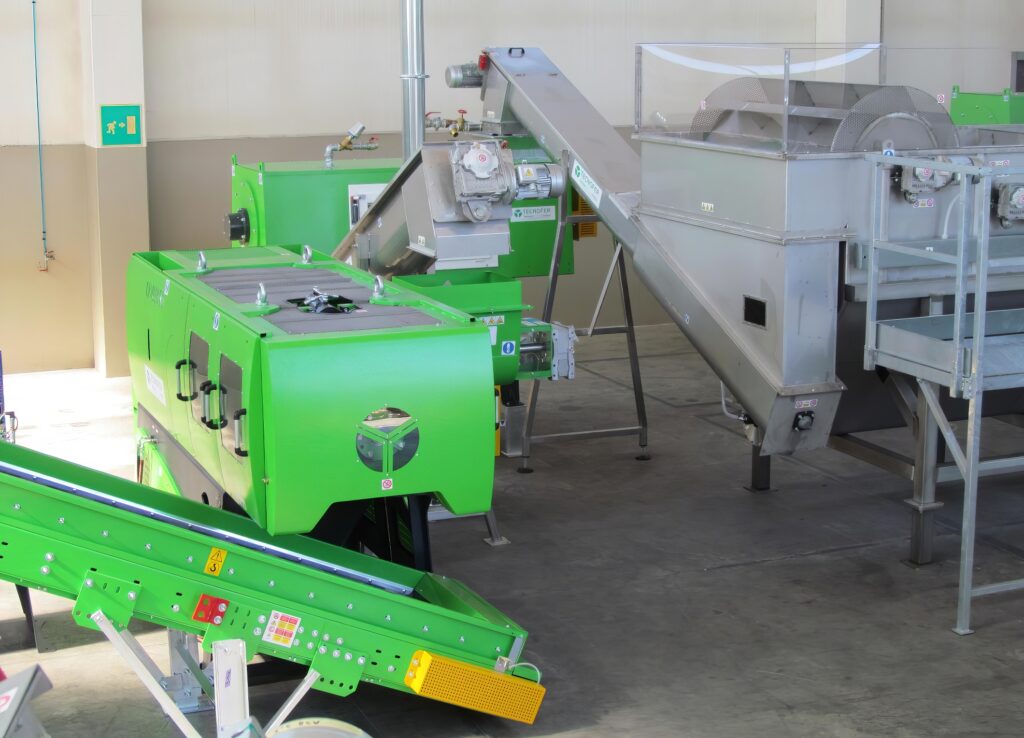
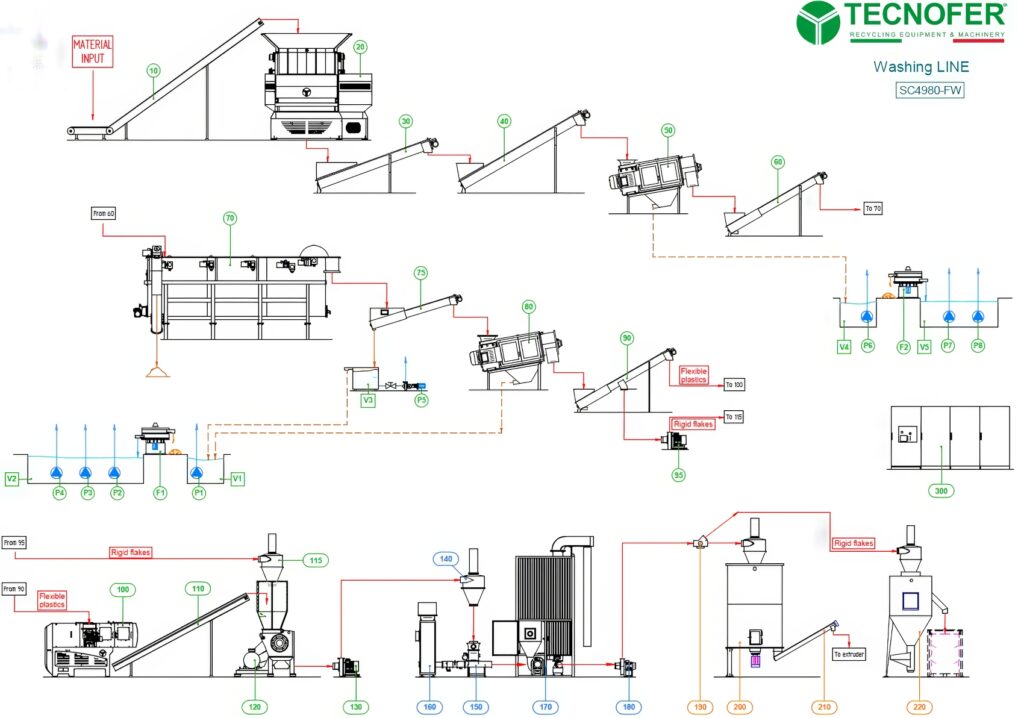
Hard Recycle delivers Tecnofer’s modular PE/PP film-washing architecture—engineered, installed, and supported locally—so you can hit throughput, cleanliness, and moisture targets with predictable OPEX. We configure the right combination of unit operations (primary size reduction, pre-wash and grit removal, high-energy friction washing, density separation, mechanical dewatering and—where required—thermal drying and hot treatment), and integrate controls/utilities to your site standards.
What we deliver (module by module)
Primary size reduction — single-shaft shredder.
A controlled first cut stabilises downstream washing by producing a consistent flake from even highly contaminated films. Rugged rotor/knife sets and screen packs are chosen to open bales and reduce sheet without creating over-fines that burden washers.
Granulation — wet/dry grinder (after the shredder).
Positioned at the front of the line, the granulator reduces the shredded film to a stable, target particle size, with or without process water depending on contamination and odour control needs. Consistent granulate size improves friction-washer efficiency, limits wrapping/jams on downstream equipment, and lets you tighten screen packs to hit cleanliness at lower water and energy use.
Pre-wash and heavy-contaminant removal.
A pre-washing/settling stage removes stones, glass, and metals before they reach wear-sensitive equipment. Hydraulics are tuned so polyolefins float while heavies settle to bottom purges, protecting pumps and washers and lowering chemistry/energy demand downstream. Wet-contact parts are stainless (AISI 304).
High-energy friction washing.
Friction washers impart intense mechanical scrubbing with high water exchange to strip soil, organics, paper and adhesives—workhorse duty for curbside film, pallet wrap and ag-film. Tecnofer’s friction washer is purpose-built for high cleanliness levels in plastic recycling lines.
Density separation (float–sink).
A washing tank separates polyolefin flakes (float) from heavier plastics/mineral residues (sink). Continuous dual discharge keeps fractions apart and stabilises residence times; wetted areas are stainless AISI 304 for durability.
Mechanical dewatering — screw squeezer.
At the wash outlet, a screw press working inside holed cylinders compacts the film; hydraulic locks impose back-pressure so flakes exit dense and low in moisture—reducing dryer energy and stabilising pelletiser feed.
Dynamic centrifuge (where beneficial).
For some blends, Tecnofer’s dynamic centrifuge provides combined wash/dry/separation on flexible or rigid fractions, improving solids removal at low power.
Thermal drying / hot treatment (as specified).
When target moisture is very low (e.g., sensitive pelletising) we size thermal dryers after mechanical dewatering; for tough inks/oils, Tecnofer’s hot-wash process couples heat, chemistry, and friction to reach higher surface-cleanliness classes.
Capacities, materials, and control
-
Throughput envelope. Tecnofer film lines are engineered across ~0.5–2.0 t/h by scaling shredder chambers, washer rotors, tank volumes, and squeezer frames—covering typical ANZ post-consumer and many post-industrial film programmes without pushing unit ops outside efficient ranges.
-
Materials of construction. Tanks and wet-contact parts are AISI 304 stainless as standard, with upgrades available where chemistry warrants—minimising corrosion and keeping surfaces smooth for sanitation and low carryover.
-
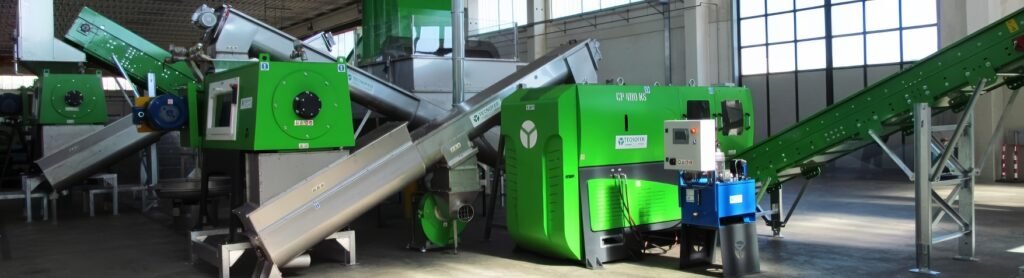
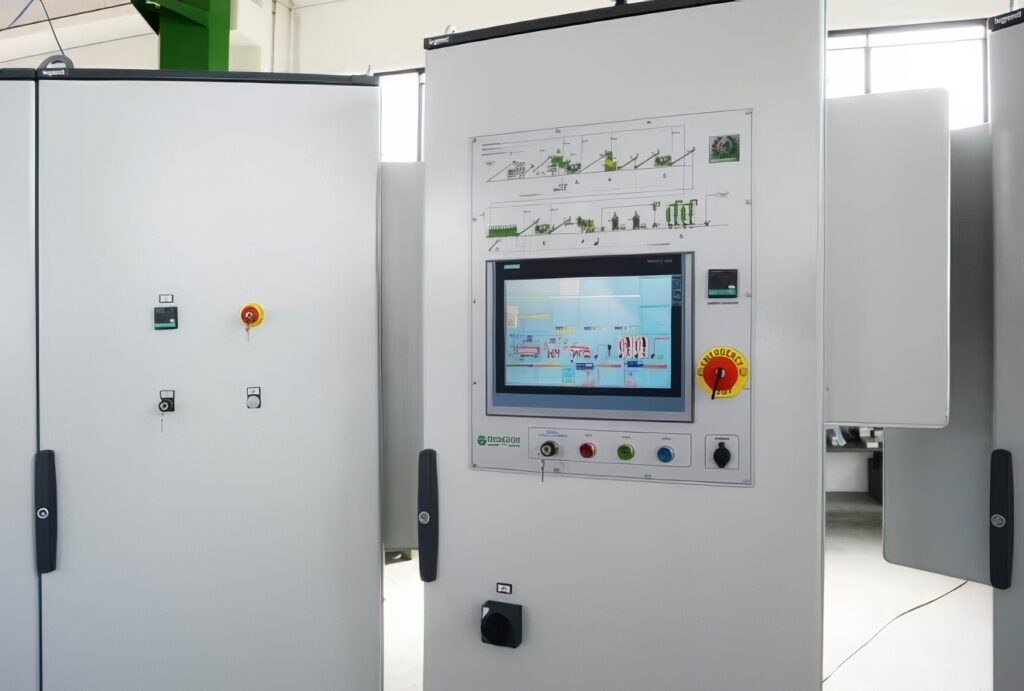
Automation & remote assistance. Lines run on PLC/SCADA with safety interlocks, production statistics, and VPN-enabled remote support for rapid diagnostics and reduced downtime; integration to site DCS/PLC is standard.
Tecnofer automation — process control, integration and remote support (detail)
-
Automated phases for productivity: process phases are sequenced automatically to maintain throughput while minimising energy and water consumption.
-
Real-time visibility & maintenance planning: the HMI/SCADA surfaces service alerts so maintenance can be scheduled and unplanned stops are reduced.
-
Industrial VPN for remote assistance: a secure router enables immediate, direct technical support for diagnostics and parameter checks.
-
Factory integration & analytics: the management layer integrates with plant DCS/PLC to expose process data and parameters for production statistics, traceability, and continuous optimisation.
How this maps to AU/NZ waste streams
-
Curbside / FOGO-adjacent soft plastics. High moisture and organics load benefit from robust pre-wash hydraulics and high-energy friction cleaning; density separation clears heavies; the squeezer delivers dense, low-moisture flake to cut dryer load and odour risk in storage.
-
Retail/PI film and pallet wrap. With lower ash, we tighten shredder screens and reduce wash residence to save water and energy while maintaining pelletising cleanliness.
-
Agricultural film (silage/stretch). Heavier soil and stones drive larger pre-wash/settling volumes and abrasion allowances, protecting washers and pumps and stabilising OPEX.
Project delivery that matches how AU/NZ plants are built
1) Define the design basis (greenfield) or sample audit (brownfield).
-
Greenfield: we co-author a design-basis feed specification with you (expected sources, polymer split, typical/peak moisture, ash, bale density, contamination profile). That spec anchors sizing and guarantees and is validated during SAT on your site.
-
Brownfield: if you already run a stream, we perform a local sample audit (moisture, ash/contaminants, film mix, fines, bale density) to parameterise shredder screens, tank residence, friction-washer tip speeds, float/sink levels, and squeezer back-pressure without shipping bulk feed overseas.
2) Parameterise with proven envelopes (no trial-and-error).
Your inputs are mapped to Tecnofer’s performance envelopes from prior PE/PP projects (retail stretch, curbside films, ag-film, etc.), providing defendable first recipes and the basis for throughput/cleanliness/moisture guarantees.
3) Factory FAT (remote witness available).
Before crating, we verify build quality, safety interlocks, control sequences and utilities with water-only checks/surrogate feed. Live tags (flows, kW, ΔP, rpm) are streamed, and the VPN remote-assistance framework is proven so post-install support is immediate.
4) Commissioning & SAT on your site (the real proof).
Start-up follows a stepped plan—cold run → wet run → clean film → design feed → upset conditions (load spikes, moisture surges, tramp removal). We tune screen packs, water exchange, washer rpm, float/sink set-points and press hydraulics until KPIs are reached.
5) Guarantees tied to measured KPIs.
Acceptance criteria are expressed as throughput (t/h), discharge moisture (%), and post-wash residuals (% or mg/kg). Where thermal drying is included, final moisture is locked; energy/water KPIs (kWh/t, L/t make-up) are trended from day one.
6) R&D-backed design—used when it reduces risk.
Tecnofer operates dedicated test lines and a lab with a large dataset of PE/PP trials. We use those data to set recipes and guarantees. If your feed/targets sit outside prior ranges (e.g., aggressive inks/oils, food-contact specs), we may recommend a targeted off-site test on a small, representative sample. This is optional and only proposed when it shortens commissioning or de-risks chemistry—no bulk shipments required.
Layout, utilities, and compliance
-
Water loop. We configure staged solids removal and controlled purge so conductivity/COD don’t drift, maintaining chemistry and reducing make-up volume—meeting licence limits while protecting washers and pumps.
-
Energy. Mechanical dewatering is the largest energy lever; by squeezing to low moisture before any thermal step, we reduce kWh/t and keep the dryer compact.
-
Controls & reporting. PLC/SCADA provides alarms, production statistics and traceability; we expose the data you need for licence reports and continuous improvement (kWh/t, L/t, uptime, rejects) and integrate with your site systems.
What you can expect in practice
-
Throughput: ~0.5–2.0 t/h depending on configuration and feedstock, sized to run inside efficient ranges rather than “just-in-case” oversizing.
-
Cleanliness and moisture fit for purpose: friction wash + float–sink deliver clean flakes; the squeezer’s low outlet moisture reduces thermal energy and stabilises extrusion; thermal drying/hot wash are specified only when required by product specs.
-
Stability & uptime: automation sequences manage transitions for productivity with lower energy/water use; remote assistance compresses troubleshooting time.
Bottom line:
With Tecnofer’s proven modules and Hard Recycle’s local engineering, AU/NZ recyclers get film-washing lines that match real feedstocks, meet licence and product-quality targets, and run with predictable OPEX. If you’re processing curbside films, retail stretch, or agricultural wrap, we’ll specify, supply, install and support the complete solution—end-to-end—from the first design-basis definition to operator handover and optimisation.